Free Patient Resource
Blood Pressure Action Pack
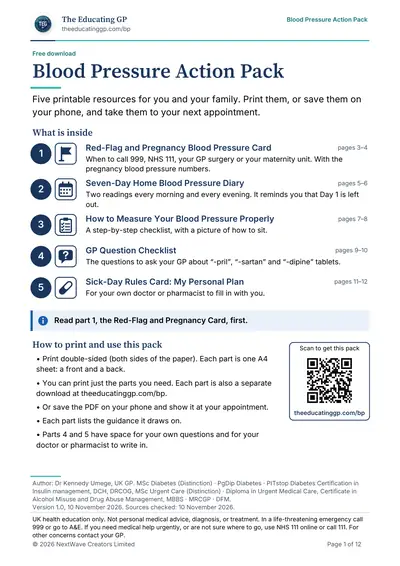
Five printable resources for you and your family. Print them, or save them on your phone, and take them to your next appointment.
Part 1 of 5
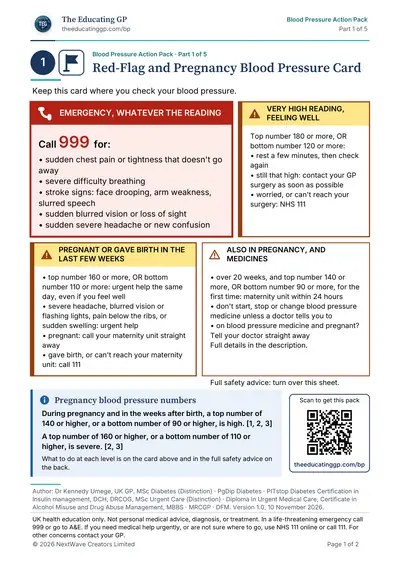
Red-Flag and Pregnancy Blood Pressure Card
Read part 1, the Red-Flag and Pregnancy Card, first. Keep this card where you check your blood pressure.
EMERGENCY, WHATEVER THE READING
Call 999 for:
- sudden chest pain or tightness that doesn't go away
- severe difficulty breathing
- stroke signs: face drooping, arm weakness, slurred speech
- sudden blurred vision or loss of sight
- sudden severe headache or new confusion
VERY HIGH READING, FEELING WELL
Top number 180 or more, OR bottom number 120 or more:
- rest a few minutes, then check again
- still that high: contact your GP surgery as soon as possible
- worried, or can't reach your surgery: NHS 111
PREGNANT OR GAVE BIRTH IN THE LAST FEW WEEKS
- top number 160 or more, OR bottom number 110 or more: urgent help the same day, even if you feel well
- severe headache, blurred vision or flashing lights, pain below the ribs, or sudden swelling: urgent help
- pregnant: call your maternity unit straight away
- gave birth, or can't reach your maternity unit: call 111
ALSO IN PREGNANCY, AND MEDICINES
- over 20 weeks, and top number 140 or more, OR bottom number 90 or more, for the first time: maternity unit within 24 hours
- don't start, stop or change blood pressure medicine unless a doctor tells you to
- on blood pressure medicine and pregnant? Tell your doctor straight away
Full details in the description.
On this page, the full safety advice is further down.
Download each part
Each part is one printable A4 sheet. Parts 4 and 5 also open with the Red-Flag and Pregnancy Card, so each of those is two sheets. The full pack holds all five.
Part 1 of 5
Red-Flag and Pregnancy Blood Pressure Card
When to call 999, NHS 111, your GP surgery or your maternity unit. With the pregnancy blood pressure numbers.
Part 2 of 5
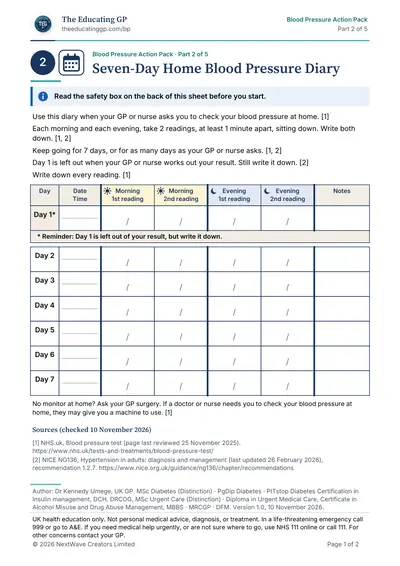
Seven-Day Home Blood Pressure Diary
Two readings every morning and every evening. It reminds you that Day 1 is left out.
Part 3 of 5
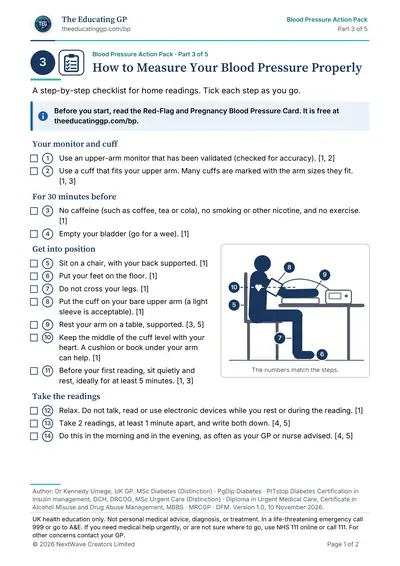
How to Measure Your Blood Pressure Properly
A step-by-step checklist, with a picture of how to sit.
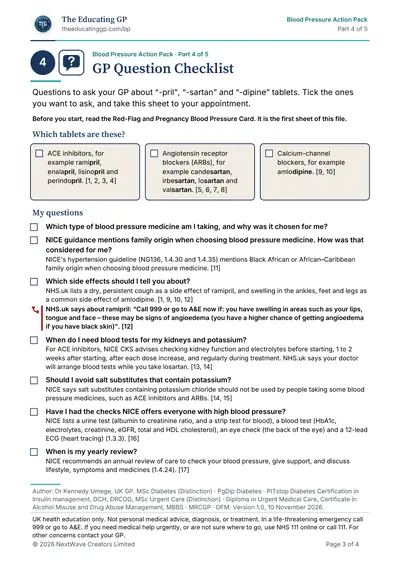
Part 4 of 5
GP Question Checklist
The questions to ask your GP about “-pril”, “-sartan” and “-dipine” tablets. This file opens with the Red-Flag and Pregnancy Card: 4 pages.
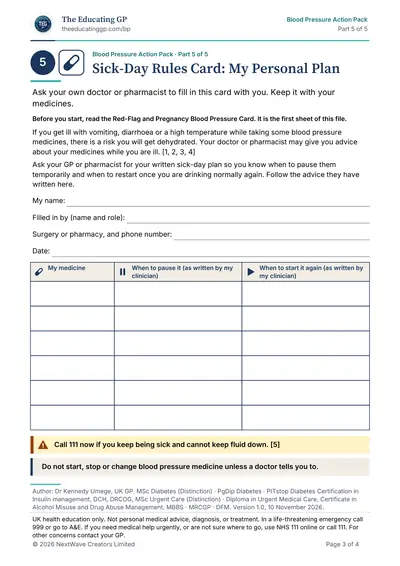
Part 5 of 5
Sick-Day Rules Card: My Personal Plan
For your own doctor or pharmacist to fill in with you. This file opens with the Red-Flag and Pregnancy Card: 4 pages.
The full safety advice
Call 999 straight away if you or someone else has sudden chest pain or tightness that does not go away, severe difficulty breathing, signs of a stroke such as face drooping, arm weakness or slurred speech, sudden blurred vision or loss of sight, a sudden severe headache, or new confusion. This applies whatever the blood pressure reading.
NICE counts blood pressure as severe when, measured in clinic, the top number is 180 or higher or the bottom number is 120 or higher. Either number on its own is enough. If either number in a home reading is at that level or higher and you feel well, rest for a few minutes and check it again. If either number is still that high, contact your GP surgery as soon as possible so it can be checked. If you're worried, or can't reach your surgery, get help from NHS 111.
If you often get headaches or blurred vision, or chest pain that comes and goes, get help from NHS 111.
If you're pregnant or have given birth in the last few weeks, different numbers apply. During pregnancy and in the weeks after birth, a top number of 140 or higher, or a bottom number of 90 or higher, is high. A top number of 160 or higher, or a bottom number of 110 or higher, is severe. If you're more than 20 weeks pregnant and either number reaches the high level for the first time in this pregnancy, contact your maternity unit so you can be checked within 24 hours, even if you feel well. If you're less than 20 weeks pregnant, or you had high blood pressure before this pregnancy, tell your midwife about a high reading, because you may need to see a specialist. If you've given birth in the last few weeks and either number reaches the high level, tell your midwife, health visitor or GP so it can be checked. If either number reaches the severe level, get urgent medical help the same day, even if you feel well. Also get urgent medical help if you have symptoms such as a severe headache that does not go away with painkillers, blurred vision or flashing lights, pain below the ribs, sudden swelling of the face, hands or feet, or feeling very unwell. If you're pregnant, call your maternity unit straight away. If you've recently given birth or can't reach your maternity unit, call 111.
Do not start, stop or change blood pressure medicine unless a doctor tells you to. If you take blood pressure medicine and find out you're pregnant, tell your doctor straight away.
About this pack
Author: Dr Kennedy Umege, UK GP. MSc Diabetes (Distinction) · PgDip Diabetes · PITstop Diabetes Certification in Insulin management, DCH, DRCOG, MSc Urgent Care (Distinction) · Diploma in Urgent Medical Care, Certificate in Alcohol Misuse and Drug Abuse Management, MBBS · MRCGP · DFM.
Version 1.0, November 2026. Each part lists the NICE, NHS.uk, BNF and WHO guidance it draws on.
Get health evidence in your inbox
Optional. The downloads above are free without signing up.
The on-page form connects to Beehiiv and shares your IP address, browser details, this page and how you arrived here. It uses tracking cookies: visit attribution for 30 days and signup or dismissal status for up to 365 days. Allowing the form does not subscribe you or allow Google Analytics. This choice lasts only while this form is open. See our cookie details.
Open Beehiiv signup instead without loading its tracking here. Beehiiv controls cookies on its own site after you follow the link.
Subscribe on Beehiiv
Get the free guide by signing up, or download the PDF directly.
We use your email only to send the newsletter. See our Privacy Policy. We never sell your data. It is processed by our newsletter provider (Beehiiv) as described in our Privacy Policy. Unsubscribe at any time.
Episode 2
High Blood Pressure at Home
Watch Episode 2 with Dr Kennedy Umege, then get the free BP Action Pack.